





 IDEEZA VERIFIED
Idea to Production: A Detailed Guide to Hardware Product Development

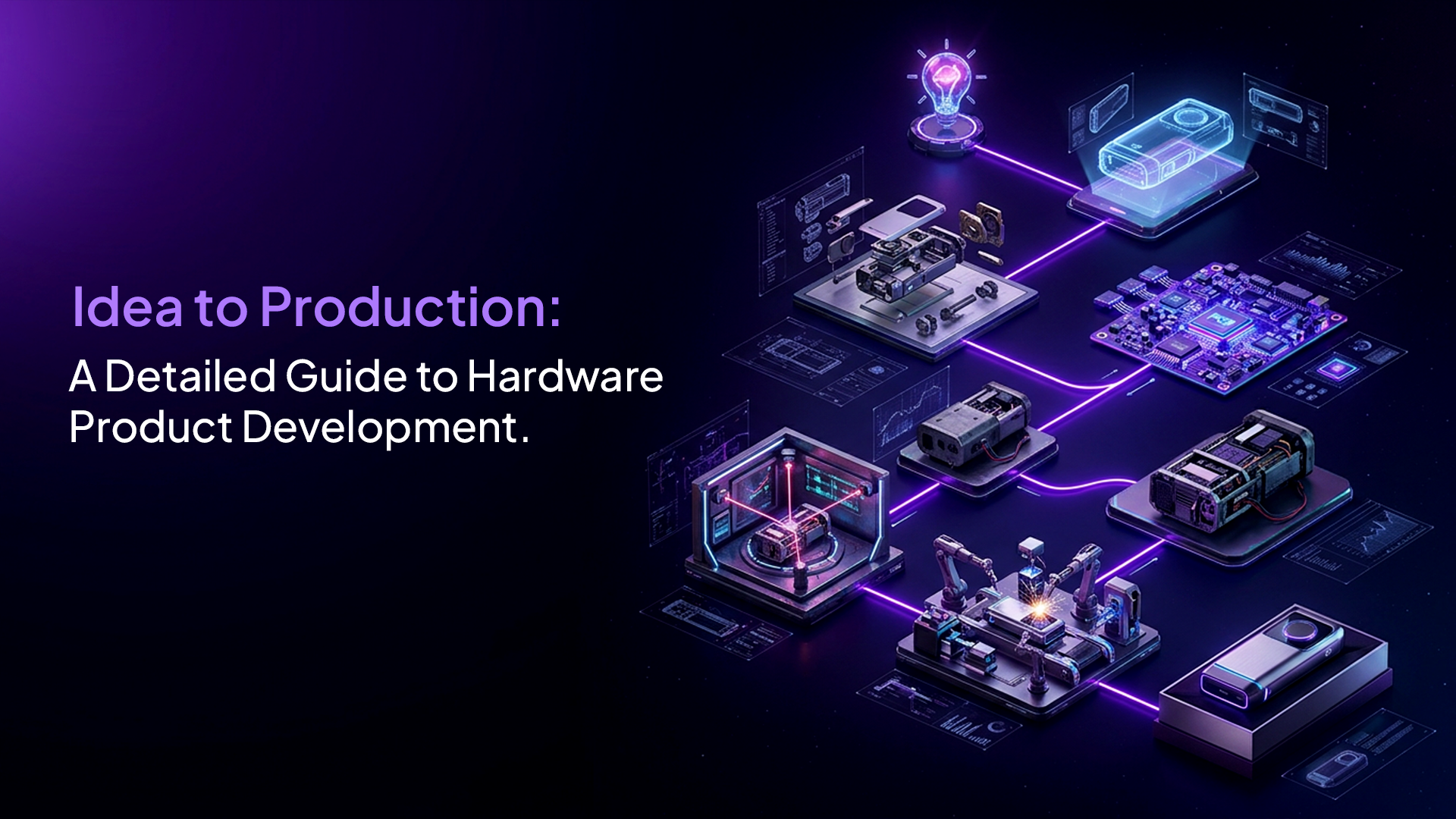
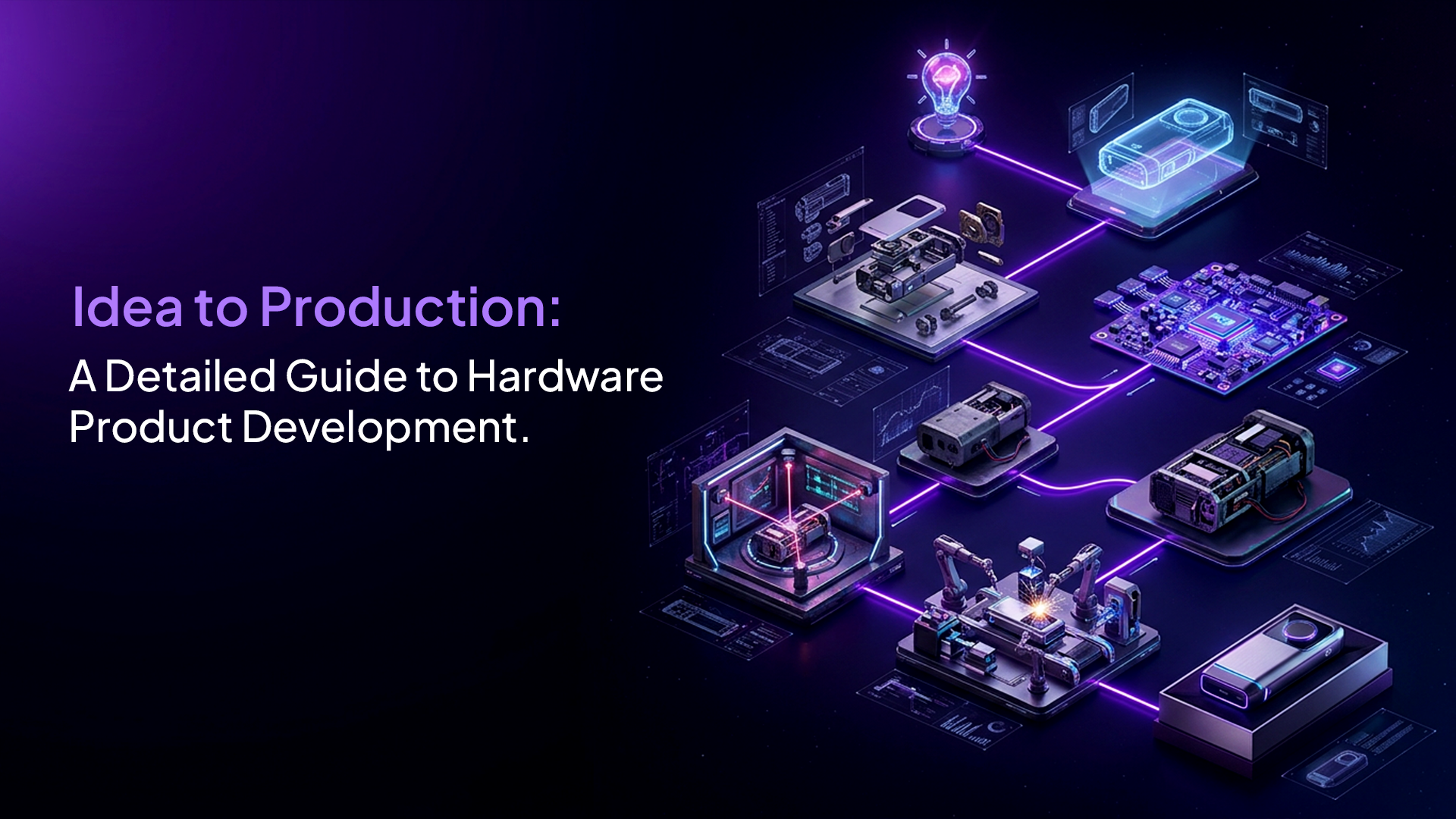
Taking a hardware concept from an initial spark to a fully realized product is one of the most challenging yet rewarding journeys in innovation. It often involves navigating technical uncertainties, coordinating across disciplines, and managing various risks while balancing time, cost, and quality constraints.
If you have ever wondered the amount of effort that goes into bringing an idea to life, this guide walks you through the crucial processes and stages of product development. It breaks down the essential stages—from ideation to production—highlighting proven methodologies, practical tips, and modern enhancements such as digital-first prototyping and concurrent engineering.
1. Ideation & Concept Definition
To start with the fact, ideas don’t make themselves. While every product in the market originates from a concept, it doesn’t reach the retail shelf just because someone simply imagined it. On the contrary, each product undergoes a rigorous development pipeline, spanning conceptualization, design, prototyping, validation, and manufacturing, before it’s ready for commercial launch. But what happens in each of these stages? Let’s find out.
Market Research & User Insights
The product development journey typically begins with understanding the problem you want to solve. This means leveraging extensive market research, surveys, and user interviews to reveal the needs and frustrations of potential customers. More often than not, this is where most creators, inventors, and entrepreneurs discover whether their idea has real-world demand or if it needs refining.
Idea Screening & Value Proposition
From here, it’s about separating the promising ideas from the impractical ones. By weighing feasibility, cost, and competitive landscape, you can prioritize the concepts with the highest potential. At this stage, defining a strong value proposition becomes crucial; it should explain clearly why your product deserves to exist, and of course, if people have to pay to have it at all.
Define Clear Objectives & Specifications
Once the idea is validated, it needs structure. A Product Requirements Document (PRD) or a simple technical specification provides that clarity. This feature specification, as it is otherwise called, outlines what the product must achieve, how it should perform, and the constraints it must consider, especially those relating to cost limitation and environmental impact.
At this early stage, it is also crucial to understand where IDEEZA fits within the broader product journey. IDEEZA currently operates between ideation and prototyping, adopting a gamification process known as “gaming level” that enables creators to move from validated ideas into structured, testable prototypes more efficiently while incentivizing the entire process. This new level bridges the common gap most teams struggle with before they can produce a prototype.
2. Design & Prototyping
Having finalized the ideation and conceptualization stage, which often sets the groundwork for any product development, the focus shifts to design. At this stage, abstract concepts start taking shape; first on paper, then on screen, and eventually in physical form.
Initial Sketches & Design Concepts
Starting with initial design concepts, most product designs often begin with simple sketches on paper, tablet, or even on a board. These rough visuals help capture the product’s basic form and user interaction. They may not be perfect, but they act as the blueprint for what comes next.
Detailed Engineering & CAD Modeling
As the idea matures, sketches evolve into digital models. Engineers create CAD designs, circuit layouts, and detailed schematics that show exactly how the product will work. Here, principles like “Design-for-Manufacturability” and “Design-for-Reliability” are applied to prevent downstream issues and reduce costs later.
Digital Prototyping & Simulation
However, before committing resources to physical prototypes, digital simulations come into play. By running computer-based tests, teams can predict performance, spot flaws, and iterate rapidly. This step dramatically mitigates wasted time and resources.
Physical Prototyping & Iteration
Of course, nothing replaces a physical prototype. By leveraging 3D printing or small-batch manufacturing, teams can build tangible models that can be touched, tested, and reviewed. Meanwhile, these prototypes provide the feedback loop necessary to refine both functionality and usability progressively.
However, it is important to note that prototyping is rarely linear. More often than not, it is a loop of building, testing, identifying issues, fixing them, and building again. This cycle can repeat multiple times until the prototype meets functional and user expectations. Even after one round of fixes, additional flaws often appear once the prototype is tested in real-world conditions, requiring another loop.
This iterative prototyping process is the foundation that determines whether a design is truly ready to scale. Interestingly, this intersection between ideation and mass production is where IDEEZA currently sits, providing both advanced AI-enabled and manual tools to fast-track this otherwise tedious process in the traditional sense.
As seen in the image above, IDEEZA is positioned at the “gaming level,” where ideas gain structure and progress into tangible, testable prototypes. This placement highlights the exact gap IDEEZA fills, enabling creators to accelerate from concept to validated prototype without being lost in uncertainty.
3. Testing, Validation & Risk Management
So what next? With a working prototype in hand, the next step is to ensure it can actually perform as intended. At this point, there is a need for product testing, which is where theory meets reality.
Iterative & Incremental Testing
The hard truth is that most products rarely work perfectly the first time. Iterative testing—building, testing, and refining—helps iron out these flaws early. In comparison, this approach is similar to the agile software methods, only that it applies them to hardware.
Testing itself can mirror the prototyping loop, with repeated rounds of re-validation whenever changes are introduced. Early testing may catch design flaws, while later tests may uncover usability or reliability issues. Each stage feeds back into another iteration cycle until confidence is established that the product can advance toward mass production.
Formal Validation Stages (EVT, DVT, PVT)
As straightforward as it may seem, most production teams approach the testing phase with clarity of purpose. Hence, to maintain structure and consistency, they typically organize the process into three well-defined stages:
- Engineering Validation Test (EVT): Validates whether the prototype functions as designed.
- Design Validation Test (DVT): Assesses performance, safety, and reliability under real-world conditions.
- Production Validation Test (PVT): Confirms that the design can be manufactured consistently at scale.
Risk Mitigation & Reliability
At the same time, risk assessment frameworks like FMEA (Failure Mode and Effects Analysis) help anticipate where things might go wrong. By addressing vulnerabilities early, teams can build products that are both durable and dependable.
Compliance & Certification
Meanwhile, managing risks is only part of the equation. For a product to reach the market, it must also pass regulatory clearance to ensure safety and compliance. Regardless of how well it performs, meeting industry standards, such as UL for safety, CE for European markets, or FCC for electronics, is non-negotiable. That goes without saying, certification is not just a box to check; it’s the gateway to market approval and consumer trust.
4. Concurrent Engineering & Cross-Functional Coordination
While testing continues, another important layer of product development takes shape: coordination.
Parallel Workflows
Instead of moving step by step, many successful teams adopt concurrent engineering, where design, manufacturing, and marketing run in parallel. This overlap shortens timelines and fosters better communication across functions.
Integrated Team Management
To make this work, strong project management is key. A central coordinator ensures different teams are aligned, dependencies are tracked, and decision-making is swift. Without this, even the most promising product can get lost in silos.
Moreover, this coordination also reinforces the iterative loop. For instance, changes in design, feedback from prototypes, or new findings in testing must be shared across functions so that manufacturing plans, marketing timelines, and risk management strategies remain aligned.
5. Manufacturing Readiness & Production Launch
Once the product design is validated and risks are under control, attention shifts to scaling production. At this stage, product teams start to plan for mass production, while striving to build an uninterrupted supply chain.
Manufacturer Selection & DfM
Most importantly, choosing the right manufacturing partner is critical. Beyond capacity, you need alignment on quality standards and costs. This is also where Design-for-Manufacturing (DfM) principles pay off, as they ensure the product can be produced efficiently.
It is also essential to note that the manufacturer responsible for prototypes is often not the same as the one for mass production. Prototype manufacturing requires flexibility for quick changes, while mass production manufacturers are optimized for consistency, scalability, and cost efficiency. Recognizing this distinction helps teams avoid delays and mismatched expectations when transitioning from prototypes to scaled output.
Pilot Runs & Scale-Up Strategy
Also, before moving on to full-scale production, pilot runs act as a dress rehearsal. At this point, production teams test assembly processes, identify bottlenecks, and give teams the opportunity to make final adjustments before committing to large-scale output.
Meanwhile, these pilot runs are essentially the final loop before true mass production. Even at this stage, feedback from a limited batch of products may surface issues that require fixes, ensuring quality and consistency before scaling to thousands or millions of units.
Supply Chain & Scalability
Similarly, production readiness also depends on the supply chain. Reliable suppliers, consistent materials, and realistic lead times must all be secured to ensure the product can scale without disruption.
6. Launch & Post-Production
After months, or sometimes years, of production work, the product is finally ready to meet the market. But this also happens in stages of post-production efforts, including:
Packaging, Distribution & Launch Strategy
First, a successful launch isn’t only about the product itself. Packaging, distribution channels, and marketing all play critical roles in shaping the customer’s first impression. Planning these in parallel with product development ensures a smoother and faster rollout.
Customer Feedback & Iterative Improvement
Just like product development takes a progressive effort, selling to prospects is not any different. Even after launch, the work isn’t done. Customer feedback provides invaluable insights into what’s working and what isn’t. Smart companies build in feedback loops to inform upgrades and future product versions.
Although this could result in an extended iterative period, the feedback loop at this stage mirrors the prototyping loop. Early customers can expose issues not visible during lab testing, forcing minor redesigns or adjustments before wider market penetration. In this way, iteration continues even after the product has entered the commercial stage.
Lifecycle Planning & Support
Finally, every product has a lifecycle. From customer support and maintenance to eventual redesigns or retirement, planning for the long haul ensures brand loyalty and sustained relevance in the market.
How to Make it All Count
The journey from idea to production is multifaceted, demanding a blend of strategic vision, cross-disciplinary collaboration, disciplined execution, and continuous learning. By combining best practices such as market clarity, agile prototyping, structured validation, risk engineering, concurrent workflows, and supply chain readiness, product teams can navigate this path smoothly and bring hardware innovations to life with confidence.