





 IDEEZA VERIFIED
Blueprint NFTs: How to Monetize Your Ideas Using IDEEZA’s End-to-End Generative AI Platform

Introduction
Too often, NFTs get dismissed as nothing more than “digital art” or “overpriced JPEGs.” That cliché misses the bigger picture. At their core, NFTs are programmable, verifiable claims over digital assets; they define what they are, who owns them, what rights come with them, and how they can evolve. When built for utility rather than hype, NFTs stop being ‘just’ collectibles and start becoming infrastructure for exchanging and scaling innovation itself.
A perfect example is Blueprint NFTs.
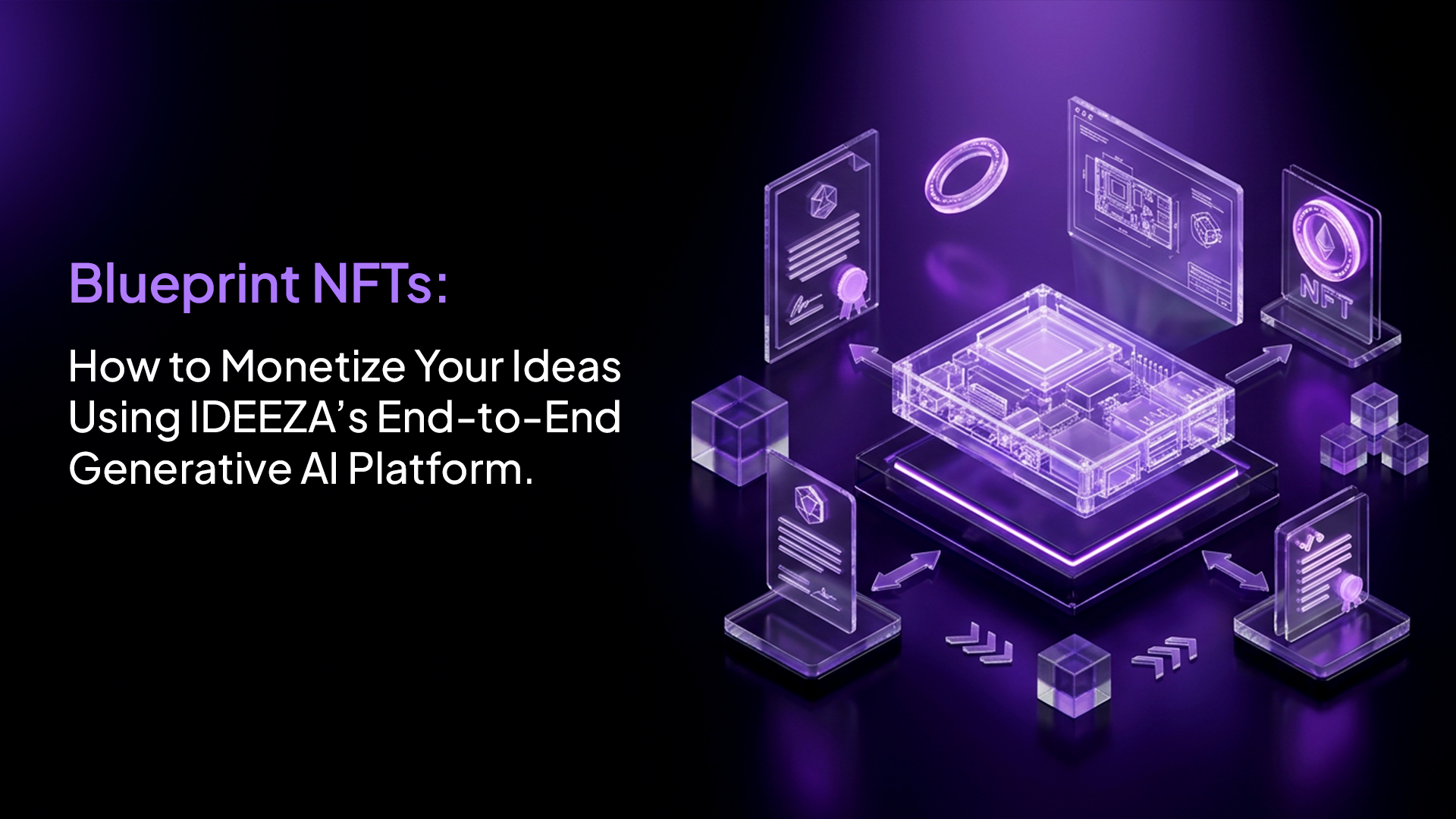
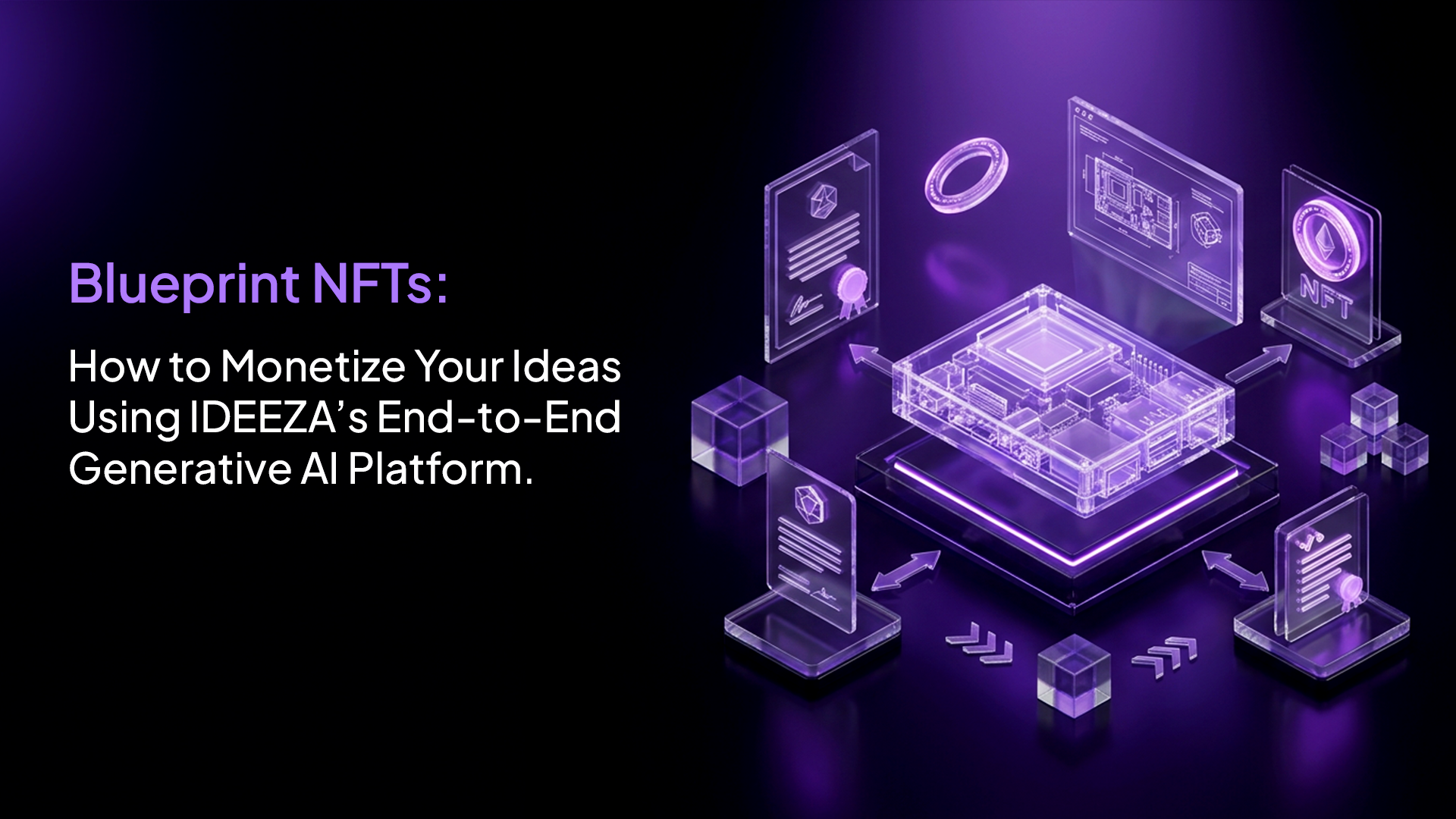
Instead of tokenizing a static picture, a Blueprint NFT binds together a structured, machine-readable description of a buildable product—CAD geometry, electronics, firmware interfaces, bill of materials, manufacturing notes, and provenance—into a single on-chain object. Ownership of that token confers transparent rights to use, license, extend, or commercialize the underlying design.
This is exactly the narrative that IDEEZA expands. IDEEZA is an end-to-end generative AI platform that converts plain-language ideas into production-grade blueprints and then turns those blueprints into on-chain tokens that can be listed, licensed, and collaboratively improved. In short: think prompts to products to property. With a native utility token, $IDZ, IDEEZA closes the loop, enabling creators to fund product generation, stake their reputation, and earn from downstream adoption.
The Evolution of NFTs
To really understand how blueprint NFTs stand apart from traditional NFT collectibles, one must first go back in time and look at how NFTs have evolved over the past decade at least.
From Uploads to Tokenization
The first wave of NFTs wrapped pre-existing media files. Creators uploaded images, songs, or short videos and attached an ERC-721 token that pointed to those files. That phase proved scarcity and provenance in a copy-paste internet, but it also revealed limits:
- Passive utility. The asset did little beyond signaling ownership.
- Speculation bias. Price discovery hinged on hype cycles more than embedded rights or cash flows.
- Creator gating. If you didn’t already have a finished asset, you had little to tokenize.
The token was innovative; the creative pipeline that fed it was not. In effect, value accrued to marketing and momentum rather than the embedded functionality of the asset.
From Prompts to Products
Generative AI changed the raw material of creation. With text-to-design systems, a user can describe intent—“heated, moisture-resistant smart gloves with adaptive thermal control and low-power BLE telemetry”—and receive structured outputs: these typically include blueprint, 3D models, enclosure geometry, electronics architecture, firmware scaffolds, and even test plans.
Meanwhile, IDEEZA operationalizes this shift. The platform ingests the prompt, reasons across libraries of components and manufacturing constraints, and composes a cohesive product blueprint.
Unlike traditional NFTs, this product blueprint is not a static PDF: it is a living bundle of maintainable artifacts and metadata. IDEEZA then tokenizes this bundle as a Blueprint NFT, making the design addressable, tradable, forkable, and upgradeable through transparent version history. The token ultimately becomes an envelope for innovation, not just a certificate.
How Tokenization Works on IDEEZA
The IDEEZA tokenization pipeline is designed for clarity and auditability. As such, it undergoes the following value chain that unlocks progressive utility, far beyond what static NFTs can offer:
- Idea Capture. You start with natural-language requirements, sketches, or reference links. The system extracts user stories, constraints, target cost, and performance envelopes.
- Generative Synthesis. AI models propose architectures: mechanical layouts, PCB topologies, sensor suites, energy budgets, and thermal profiles. Conflicts are resolved with constraint solvers and rule-based checks.
- Blueprint Assembly. Outputs are normalized into a canonical structure: 3D models, schematics, firmware stubs, UX flows, BOM with supplier options, compliance notes, and test procedures. Each artifact is content-addressed for integrity.
- Rights & Policies. You select licensing defaults (e.g., commercial license with attribution, royalty splits for collaborators, or derivative permissions). Policy metadata is embedded for enforceability.
- Tokenization. The blueprint is minted as a Blueprint NFT using standard NFT interfaces for portability (e.g., ERC-721/1155), with an on-chain pointer to immutable content storage and a manifest of rights.
- Distribution. The token is listable on the IDEEZA Marketplace and discoverable by manufacturers, integrators, and other builders. Off-chain collaboration tools keep the blueprint evolving while the token tracks provenance.
- Settlement & Royalties. Smart-contract hooks automate primary sales, secondary royalties, and license issuance to buyers or partners.
Meanwhile, throughout this flow, the native $IDZ token serves as the economic engine:
- Creation fuel. Generating blueprints and running heavier synthesis passes consumes $IDZ, aligning the compute cost with the user.
- Incentive alignment. Creators earn $IDZ from sales, licenses, or bountied improvements. Reviewers and validators can be paid in $IDZ for audits or tests.
- Ecosystem growth. Project treasuries and community pools distribute $IDZ to promising designs, funding prototypes, or certification.
By pairing technical traceability with a native incentive layer, IDEEZA turns ideation into a measurable, investable workflow.
Monetization Opportunities
Early NFT Monetization Models
Early playbooks emphasized collectibles: In the past, limited editions, community passes, or art that derived value from cultural momentum attracted monetary or redeemable value. Those models taught useful lessons about scarcity, fair secondary royalties, and community coordination. But they seldom attached defensible cash flows. Utility, when present, was social—access to chats, airdrops, or events, and not operational—rights to manufacture or license IP.
Modern Monetization with IDEEZA
Blueprint NFTs create direct, operational monetization paths:
- Marketplace Listings. Users can list their Blueprint NFT on IDEEZA with clear license terms: buyer obtains rights to manufacture N units within a region, or to integrate the design into derivative products. Pricing can be flat, tiered by volume, or subscription-based for access to updates.
- Secondary Distribution in Virtual Worlds. The same blueprint can be compiled to a high-fidelity digital twin for metaverse or simulation use—demonstrations, marketing, or training—creating parallel revenue from virtual deployments while preserving industrial IP.
- Ongoing Royalties. Smart contracts route secondary sales and sublicensing fees back to originators. If a manufacturer resells derivative rights, the original creator receives ongoing percentages without manual reconciliation.
- Co-creation & Revenue Sharing. Invite specialists—thermal engineers, firmware developers, industrial designers—to contribute improvements. Their contributions are checkpointed and their revenue shares codified in the token’s royalty graph. The result is an open, meritocratic pipeline where value tracks verifiable contributions.
- Service Attachments. Offer paid support, calibration profiles, firmware updates, or compliance packs as token-gated add-ons. Holders unlock the latest builds and safety documentation.
- Manufacturing Bounties. Commit $IDZ to bounties that de-risk the path to production: DFM reviews, certification pre-scans, or pilot builds. Contributors claim bounties by attaching validated reports to the blueprint’s history.
- Licensing to Vertical Integrators. Enterprises can license families of blueprints to accelerate product lines, paying predictable fees while reducing R&D start time.
In all cases, the token is more than a receipt—it is the programmable payment rail and audit log that binds the commercial story to the technical one.
Why IDEEZA Stands Out
End-to-end generative AI platform
Many NFT platforms assume you already have a finished asset. IDEEZA begins earlier, converting intent into artifacts that survive contact with manufacturing—BOMs tied to suppliers, constraints verified against standards, and firmware that boots. That upstream intelligence is what makes the downstream token commercially meaningful.
Integrated NFT marketplace
Discovery, licensing, escrow, and fulfillment live under one roof. Buyers do not have to piece together rights from external legal docs; the license is defined in the token metadata and enforced in transfers and license keys.
Blueprint NFTs as a new asset class
These tokens carry structure—modules, versions, dependency graphs—and therefore support governance: forks, merges, changelogs, and attestations. That makes collaboration safe: you can trace exactly which module introduced value and route royalties accordingly.
$IDZ-powered ecosystem
Because $IDZ funds compute, rewards reviews, and pays creators, the token recirculates rather than leaking to generic payment rails. Communities can collectively back blueprints they want to see built, and manufacturers can signal demand by staking $IDZ toward procurement or NRE (non-recurring engineering) costs.
Compliance-aware by design
Hardware and regulated domains thrive on traceability. Embedding test artifacts, calibration data, and certification checklists into the blueprint gives purchasers a head start toward CE, FCC, or other marks. When a buyer pays for “manufacture-ready,” they receive auditable evidence—not just a pretty render.
Interoperable and future-proof
By using standard token interfaces and content addressing, Blueprint NFTs can be bridged to partner marketplaces, enterprise PLM systems, or simulation environments without rewriting the IP stack. Your asset remains portable as the ecosystem evolves.
Conclusion
NFTs began as wrappers for media, but the next era packages real utility. A Blueprint NFT is a compact contract showing the parts, how they fit, the rights you gain, and how improvements flow back—working only when blueprints are clear and incentives align. IDEEZA enables this shift from uploads to tokenized blueprints, compressing months of engineering into hours, turning design into demand through its marketplace, while using $IDZ to fuel creation, validation, and royalties.
For creators, the message is simple:
You no longer need a factory, a CAD team, or a legal department to begin monetizing your ideas. Start with a well-phrased prompt, iterate until the blueprint meets your preference, mint the result as a Blueprint NFT, and let the marketplace and collaborators compound its value.
For manufacturers and integrators, Blueprint NFTs are a discovery engine for ready-to-license IP, coupled with provenance and technical depth. In other words, NFTs have matured from art objects into vessels for innovative ownership, and IDEEZA bridges the gaps between ideas, blueprints, tokenization, monetization and collaboration.
If the first wave of NFTs proved digital scarcity, the next will prove something far more consequential: that invention itself can be generated, owned, shared, and fairly rewarded at internet scale. Moreso, because every artifact inside the token is addressable and versioned, buyers can verify lineage, teams can run automated checks, and auditors can reproduce results.
That is what turns a token into an actual asset: verifiable structure, enforceable rights, and incentives that reward real-world adoption. With Blueprint NFTs on IDEEZA, that future is not speculative, it is operational.