





 IDEEZA VERIFIED
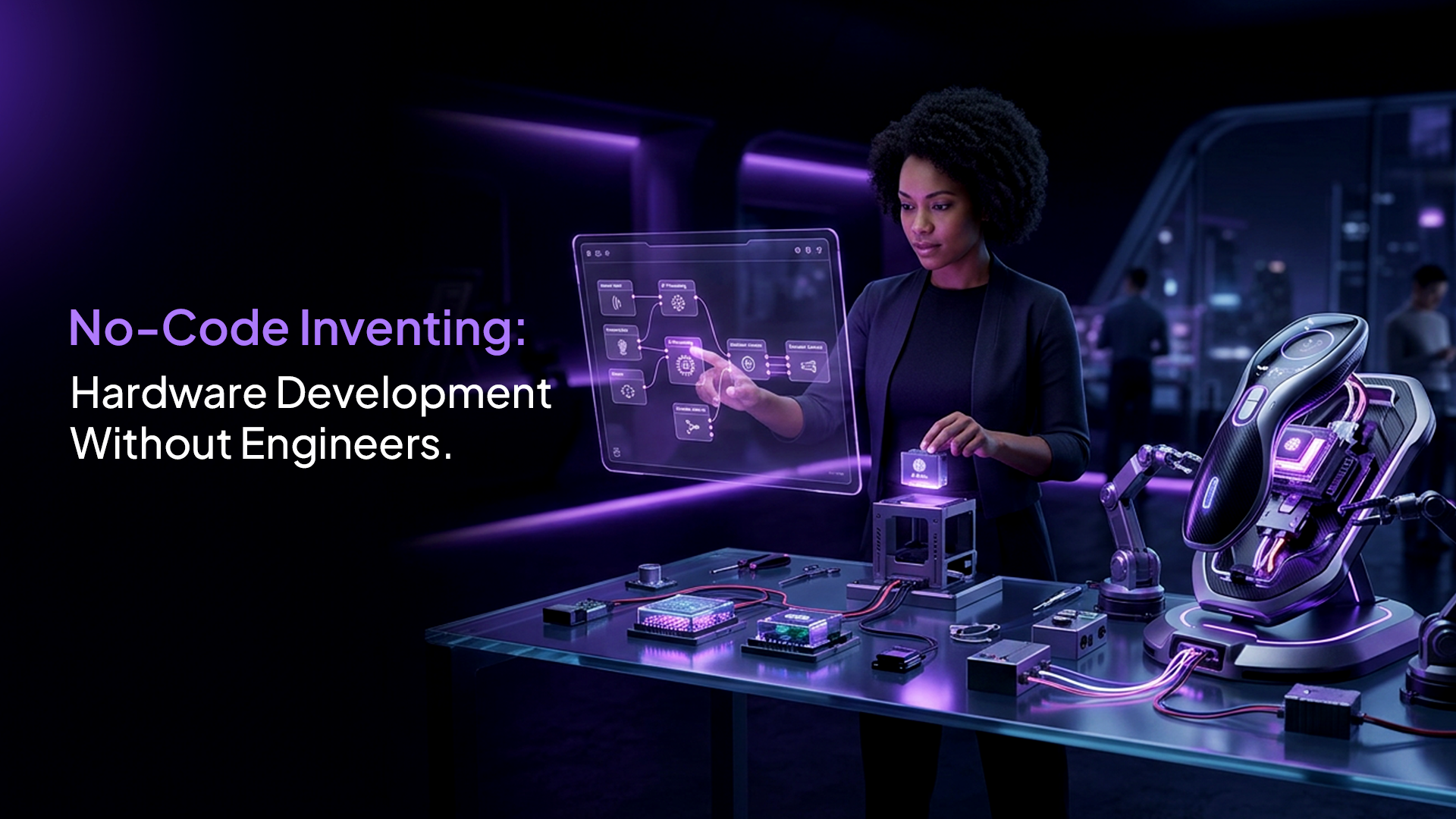
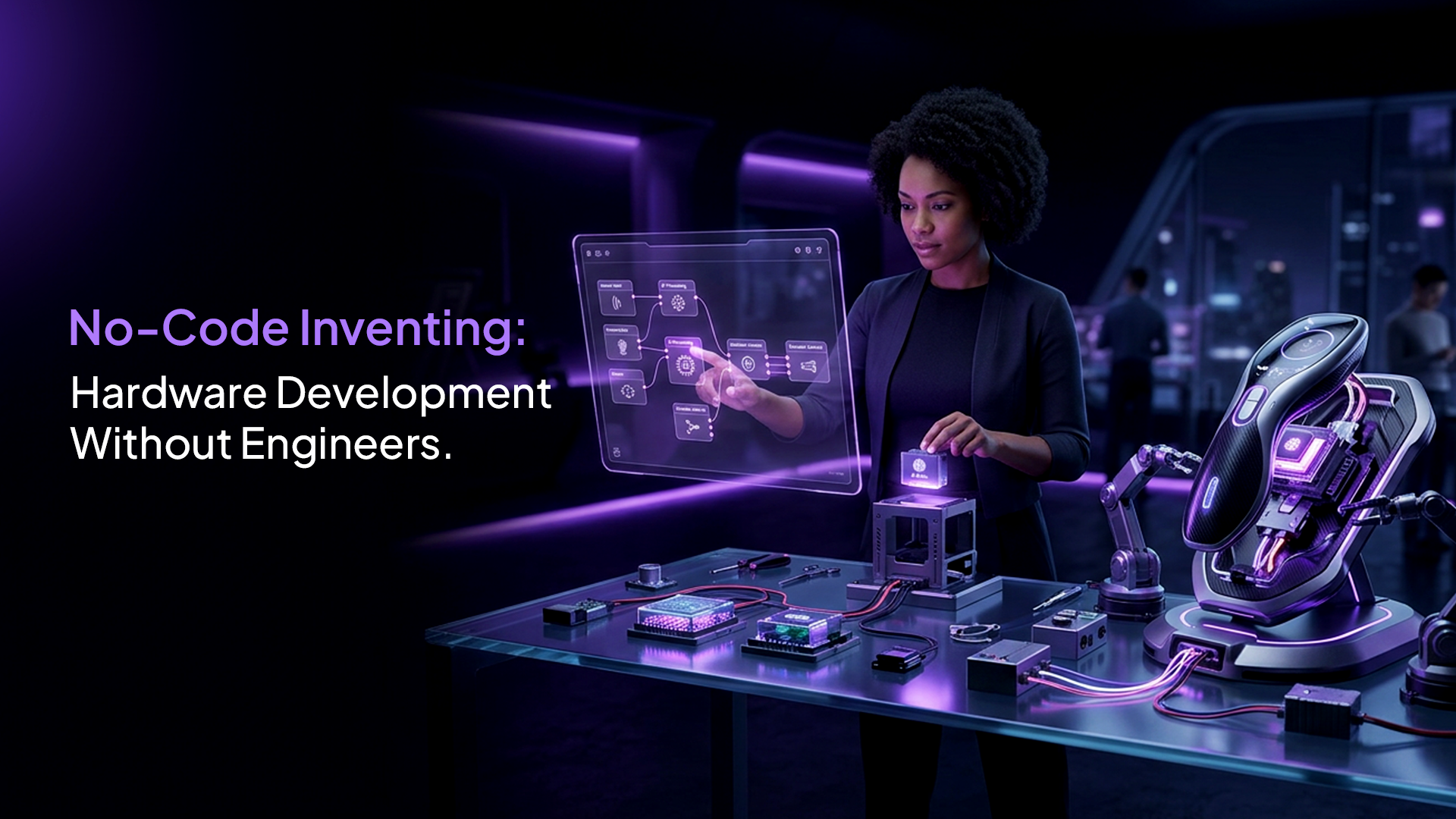
No-Code Inventing: Hardware Development Without Engineers

Introduction
For decades, the dream of invention has been tied to barriers that kept everyday innovators on the sidelines. If money weren’t the limitation, it would either be tools you can’t access, codes you couldn’t write, or engineering expertise you didn’t have.
Today, a different path is opening. Generative AI is eliminating these barriers by transforming plain-language ideas into technical digital assets. With AI, the first draft of a design is no longer a blank page — it’s a structured blueprint. IDEEZA is leading this shift by giving people a way to move from idea to blueprint to market without needing to hire engineers or learn CAD. The result is genuine no-code hardware development.
This article traces the journey of invention, showing how AI extends the no-code revolution from software into physical products. It also explains how IDEEZA’s ecosystem—Generative AI, AI-to-blueprint technology, Blueprint NFTs, Marketplace tools, and Decentralized Manufacturing—democratizes product innovation for solopreneurs and startups alike.
The Historic Journey of Invention
How It Started — Inventing 10, 20, 100+ Years Ago
About a hundred years ago, invention was a craft practiced in workshops and garages. Then, progress solely depended on trial-and-error, handmade jigs, and a deep tolerance for setbacks.
Most of the process was tacit knowledge: you learned by burning fingers on soldering irons and by filing, bending, and re-bending sheet metal until it fit. Access to tools and materials was inconsistent, and scaling beyond a prototype required funding and relationships most individuals didn’t have.
The Industrial Era Shift
The Industrial Revolution pulled invention out of basements and into labs, corporations, and R&D centers. Specialized roles multiplied: mechanical engineers, electrical engineers, industrial designers, manufacturing planners, patent lawyers.
While product quality was now predictable with mass production becoming possible, builders still faced a higher bar to entry. Innovation became gated by credentials, capital, and institutional access. The history of invention and product development, in effect, shifted from tinkerers to teams.
The Modern-Day Limitations
Despite accessible software, modern hardware still demands a heavy stack: coding for firmware and connectivity, electronics design, CAD modeling, compliance testing, prototyping budgets, and manufacturer relationships. These modern product development challenges exclude everyday creators unless they bring money or rare skills to the table.
Meanwhile, plenty of people spot real-world problems; albeit, very few can turn those observations into manufacturable designs on their own.
How Generative AI Transforms This Narrative?
From Code-Free Apps to Hardware-Free Building
The past decade popularized no-code in software. Website builders, form tools, workflow automators, and app creators let non-programmers ship real digital products. Generative AI extends the logic to atoms, not just bits. Instead of writing code or drawing every line in CAD, a creator can describe intent.
For instance, they input a prompt; “a modular, wall-mounted herb garden with moisture sensors and a simple mobile alert”. Afterwards, they receive a draft architecture, 3D model, component lists, enclosure concepts, and interaction flows.
No-code inventing becomes practical when the system translates natural language into working design primitives.
How Generative AI Unlocks Hardware Development
Generative AI unbundles the most time-consuming, expertise-heavy steps:
- Transforms ideas into structured, technical blueprints by mapping functions to components, interfaces, and constraints.
- Generates 3D models in minutes, enabling fast 3D modeling with AI.
- Proposes electronics layouts, firmware stubs, and BOM options based on cost, availability, and manufacturability.
- Automates repetitive engineering chores—mounting bosses, tolerances, wiring harness routing—ultimately delivering cost-effective hardware design.
- Supports AI-driven prototyping, so iterations happen before a single part is machined.
What Artificial Intelligence (AI) Changes—and What It Doesn’t
It’s important to know that AI is not a magic wand that trivializes physics or manufacturing realities. Tolerances, materials, thermal performance, and safety constraints still matter. What changes is the ratio of thinking to tinkering.
Instead of spending three weeks drawing enclosure variants just to evaluate airflow, a creator can ask the system to produce options that satisfy cooling and ingress-protection targets, then choose based on trade-offs. However, in all of these, human judgment remains central — defining goals, setting constraints, and deciding when “good enough” is actually good enough.
IDEEZA’s Role in the Future of No-Code Invention
Build Without Coding or Hardware Knowledge
IDEEZA Generative AI converts plain language into buildable design assets. A user describes the problem and desired behaviors; IDEEZA’s AI-to-blueprint technology performs AI idea-to-blueprint conversion, turning that description into schematics, enclosure geometry, and manufacturable files. The platform abstracts away firmware boilerplate and CAD minutiae, so non-engineers can produce outputs that engineers respect.
Iterate Faster, Build Smarter
Iteration is where most projects stall. With traditional tools, small changes require re-drawing parts and re-verifying fits. IDEEZA’s product blueprint creation treats designs as living systems. Creators can tweak parameters—dimensions, power budget, communications protocol—and regenerate updated models in minutes.
Compared to conventional workflows, IDEEZA AI platform reduces early dependency on full engineering teams and makes experimentation cheap. For startups, that means a shorter path from insight to demo; for enterprises, it means more concepts tested with the same budget.
Blueprint NFTs and Market-Ready Products
Because ownership is as important as invention, IDEEZA integrates blockchain to secure intellectual property from day zero. Creators can mint Blueprint NFTs that time-stamp authorship, encapsulate rights, and unlock monetization.
More interestingly, a designer can license a blueprint to a manufacturer, sell limited production rights, or collaborate with contributors through the IDEEZA NFT marketplace. Because the outputs are generated in manufacturing-ready formats, the step from concept to pilot run becomes a handshake rather than a cliff.
A Connected Ecosystem: Social Feed, Marketplace, and Decentralized Manufacturing
Beyond design, IDEEZA supplies the rest of the pipeline. The IDEEZA Social Feed helps teams gather feedback and document decisions. The IDEEZA Marketplace connects inventors with suppliers, prototyping shops, and assemblers.
A decentralized manufacturing layer means production can be routed to qualified partners close to demand, reducing shipping and lead times. The result is an end-to-end environment where no-code product creation doesn’t dead-end at the CAD viewer; it continues into parts on a bench and products in a box.
From Idea to Blueprint in 30 Minutes: A Walkthrough
- Describe intent in natural language: who the product serves, where it lives, and how it should behave.
- Add constraints: dimensions, target battery life, connectivity, rough BOM cap, certifications to consider.
- Generate: IDEEZA composes architecture, suggests components, drafts schematics, and produces a 3D enclosure.
- Inspect and iterate: change enclosure shape, swap a sensor, adjust power budget, or request alternative BOMs optimized for cost or availability.
- Validate: run basic simulations or rule checks for thermal, fit, and manufacturability.
- Secure: mint a Blueprint NFT to log authorship and version.
- Share and source: post to the Social Feed for feedback, then request quotes through the Marketplace or route to decentralized manufacturing partners for prototypes.
This loop converts what used to be weeks of email, meetings, and drawings into an afternoon of focused decision-making.
Blockchain’s Role in Democratizing Innovation
Secure Ownership of Ideas
Traditional IP protection is slow and expensive. Blockchain offers instant IP protection for creators by recording a tamper-resistant, time-stamped proof of creation. In the IDEEZA blockchain ecosystem, the record travels with the blueprint across reviews, revisions, and collaborations. Besides, auto-NDA mechanisms make it practical to invite experts to collaborate without risking leakage, while auditable histories build trust between strangers who need to work fast.
Global Marketplace for Invention
A marketplace is only as strong as its incentives. By using tokens or on-chain receipts to track rights and payments, contributors can be rewarded proportionally: a sensor specialist who improves a layout, an industrial designer who refines ergonomics, a manufacturing partner who suggests a cheaper process.
The IDEEZA Marketplace formalizes these exchanges so small teams can behave like well-funded R&D groups. Transparency and accountability are not add-ons; they are built into every transaction..
Why This Matters for Solopreneurs, Inventors, and Innovators
Breaking Down Barriers
No-code hardware development removes three historical limits:
- Funding: early exploration no longer requires large prototyping budgets.
- Knowledge: creators leverage AI for electronics, firmware, and CAD rather than mastering each craft upfront.
- Tools: cloud access replaces specialized, expensive equipment for the earliest stages.
For solopreneurs and students, these shifts open a path that simply didn’t exist ten years ago. At a practical level, IDEEZA supplies tools for solopreneurs—an integrated set of generators, validators, and marketplaces that put professional capability behind a simple interface.
Accelerating the Future of Product Development
Speed, cost, and risk drive adoption. With IDEEZA:
- Time-to-market shrinks as AI handles first drafts and repetitive redesign.
- Costs drop because many design loops happen virtually and automatically.
- Risk falls thanks to simulation, component alternatives, and manufacturability checks baked into the flow.
The business impact is tangible: startups gain no-code solutions for hardware; enterprises pilot more ideas with the same headcount; and the global pool of problem-solvers expands by orders of magnitude. In short, democratizing product innovation stops being a slogan and becomes a daily practice.
Use Cases: From Classrooms to Commercial Launches
- Education: STEM classes turn ideas into tangible projects without a machine shop. Students learn systems thinking by iterating on real devices.
- Assistive tech: caregivers design custom aids tailored to a person’s environment—mounts, switches, or sensing tools that would never appear in mass markets.
- Smart agriculture: smallholders create low-cost monitoring devices adapted to regional crops and climates.
- Sustainability: entrepreneurs test circular-design concepts, from repair-friendly enclosures to sensor-enabled reuse schemes.
- Consumer gadgets: indie creators pilot niche products and validate demand before committing to molds.
Across domains, the common thread is speed and access: ideas move from conversation to artifact while budgets remain sane.
Where Engineers Fit In
No-code invention doesn’t erase engineering; it concentrates it where it matters most. Experts review safety-critical elements, compliance, and scale-up decisions. Because IDEEZA front-loads clarity—requirements, constraints, and draft assets—engineers can engage later with more context, reducing back-and-forth and letting small teams punch above their weight. The collaboration is complementary, not competitive.
Conclusion
Invention has traveled from solitary workshops to institutional labs and, too often, to closed doors. The requirements of huge funding, specialized tools, and deep technical knowledge made hardware innovation slow, expensive, and exclusive. But Generative AI changes that trajectory. By translating natural language into blueprints, producing fast 3D models, and automating engineering chores, AI turns possibility into process.
IDEEZA pushes that transformation into an actionable ecosystem. Its Generative AI and AI-to-blueprint technology let non-engineers build without coding. Its Marketplace, Social Feed, and decentralized manufacturing connect designs to production. And its Blueprint NFTs, NFT marketplace, and blockchain layer protect ownership while enabling collaboration.
When anyone with a credible idea can produce market-ready AI blueprints, we get more attempts, faster iteration, and a richer pipeline of products addressing real problems. That is the promise of no-code inventing—hardware development without engineers at the starting line, and a level playing field for creators everywhere.